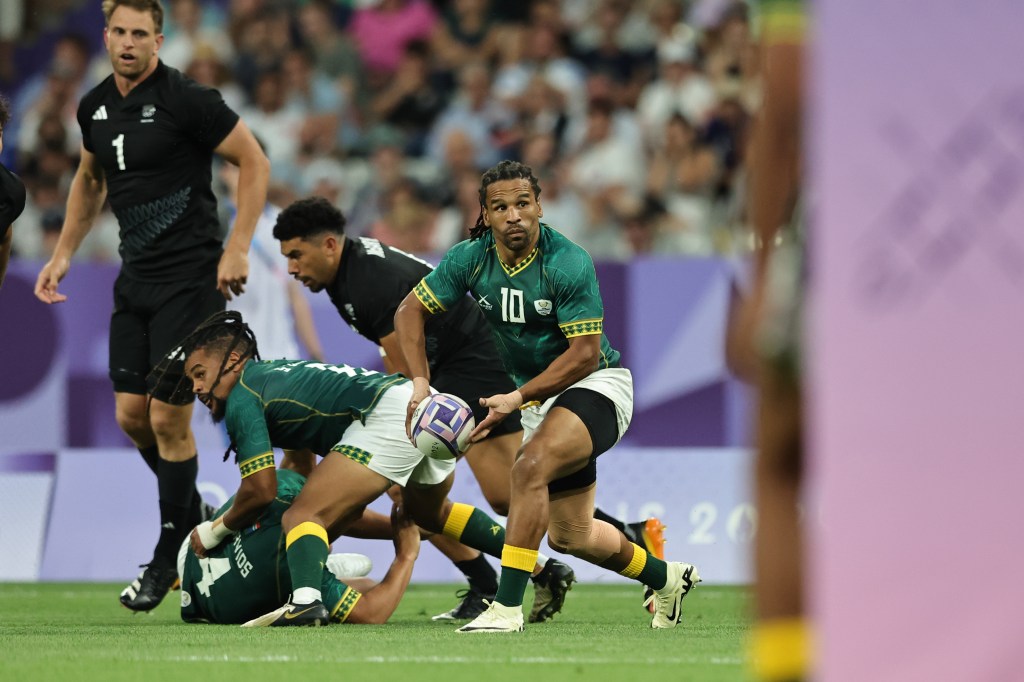
Ten years after winning a bronze medal in Rie de Janeiro with the South Africa seven-a-side rugby team, Rosko Specman launched his coaching career in January, 2026 in Brazil with a franchise side Cobras Brasil Rugby that competes in the Super Rugby Americas championship.
During the third leg of the World Rugby Sevens 2 competition in Sao Paulo, Brazil, www.thesportsnewsarena.com caught up with the two-time Olympian who talked about his player-coach role, how he was approached, and his brief stint at the franchise. With his trademark dreadlocks and sunglasses, Speckman who identifies as a people’s person was easily at Estadio Nicolau Alayon located in the Barra Funda district of Sao Paulo, the home ground of the team and venue of the Sevens tournament.
On the opening day, Specman traveled to Argentina for a match but club officials confirmed he would be available on the next day for an interview. At about mid-morning, we spotted the player and arranged for an interview. The first thing he did was grab my phone and take a selfie! Who does that?
Squeezed Interview
A few hours later, we squeezed in an interview as Belgium, the overall winners of the Sao Paulo leg made their way to the stadium and not before Specman briefly talked to a former teammate Cecil Afrika who is now coaching the South Africa women’s 7s team.
Specman recalled his appearance at the 2016 Olympics which impacted his decision. He admired the Brazilian cultural environment which made it easy to take up the appointment.
He began: “So far the journey in Brazil has been going fine even though the results for us have not been favorable. It is not an easy competition.” This was in reference to the Super Rugby America competition that has four teams from Argentina and one each from Brazil, Chile, Paraguay and Uruguay.
These are Pampas (Buenos Aires), Dogos XV (Cordoba), Tarucas (NOA), and Capibaras (XV (Litoral/Rosario), Cobras Brasil XV (Brazil), Selknam (Chile), Yacare XV (Paraguay), and Peranol Rugby (Uruguay). The regular season runs from mid February through to mid June.
Cobras Debut
Specman made his debut for Cobras Brasil Rugby on February 23, 2026 against Dogos XV in Cordoba, Argentina. “The cobras have something special. There are a lot of young players who have a rare opportunity to play in the South America competition. It is not an easy competition because of the composition involving teams from Argentina, Brazil, Uruguay, Paraguay, and Chile. The aim is to grow rugby in Brazil,” he explained.
When asked about his role as player-coach, Specman suppressed a ready smile and answered: “It’s a new thing but I am enjoying the experience. Most of the time I am a player. Off the pitch I am a coach. After the game I do a lot of analysis and come out with a plan for the new week,” Specman answered.
His move to Brazil was described by rugbypass.com as ‘unorthodox’ probably because Brazil is synonymous with football and not rugby. In an interview with the portal, the explosive runner with an unpredictable side-step acknowledged his bold move as a privilege and an opportunity to share his experience and give back to the game. “The role I have been offered as player-coach will allow me to do just that,” he told the portal.
People Pleaser
Specman told SNA: “I got this gig through friends. I am a people pleaser and people like me. The offer came through a conversation and I decided it was a good opportunity to come over. Winning a bronze medal in Rio in 2016 was memorable so it is a good place to come and start my coaching career,” he added.
Although Specman, who plays alongside five other South African players, an Argentinian and an American, simplified his role, the task has been daunting. It is a continuous learning experience, growth, and development of players who are likely to play a big role in the national team.
Since Specman’s had a familiar DNA in the shorter version of the game, it was inevitable we picked his brains on the recent changes that has seen World Rugby adopt a three-tier competition. He admitted the change has brought a lot of emotions to the competition.
“It is an opportunity to test yourselves against the best. Try and win at every stage even if it is in tier two or three. It gives teams an opportunity to dominate the series and qualify for the top eight,” he observed of the second tier competition.
Cecil Afrika
The likeable player had good words for the current coach of South Africa women’s team, Cecil Afrika. “He is doing something special and has included a lot of young players in the team. The more we can see the new generation coming through, the better. It is a good feeder system to the teams, especially the national teams. A lot of these young players are progressing in the right direction. The girls just need self belief, believe in the structure and the results will come.”
Afrika he recalled was “ a spectacular player in his days and that is a nice thing to give back from his experience. It’s good to see Cecil give his skills and knowledge to the girls.” Afrika’s role as coach added an interesting dimension on the technical bench of other teams who have trusted former players with the tough job.
Former Players
For example, South Africa, the USA, New Zealand, Argentina, and Spain, among others, have former players as coaches. Specman noted: “The nicest thing about the new coaches now is that they have played against each other and now they must face each other as coaches so there are a lot of ideas. At the end of the day the guys are still friends,” he observed.
Lastly, Specman said South Africa’s domination of major competitions was a result of investing in grassroot development. “We just want to inspire each other. There is a system from the age group right up to the top.” The interview would not have been complete without asking Specman about his faith. “My faith is the foundation of my career. Whether I make the team or not, I have faith . Sometimes, if you just sit still, the answers shall be provided.”


 Sports News Arena