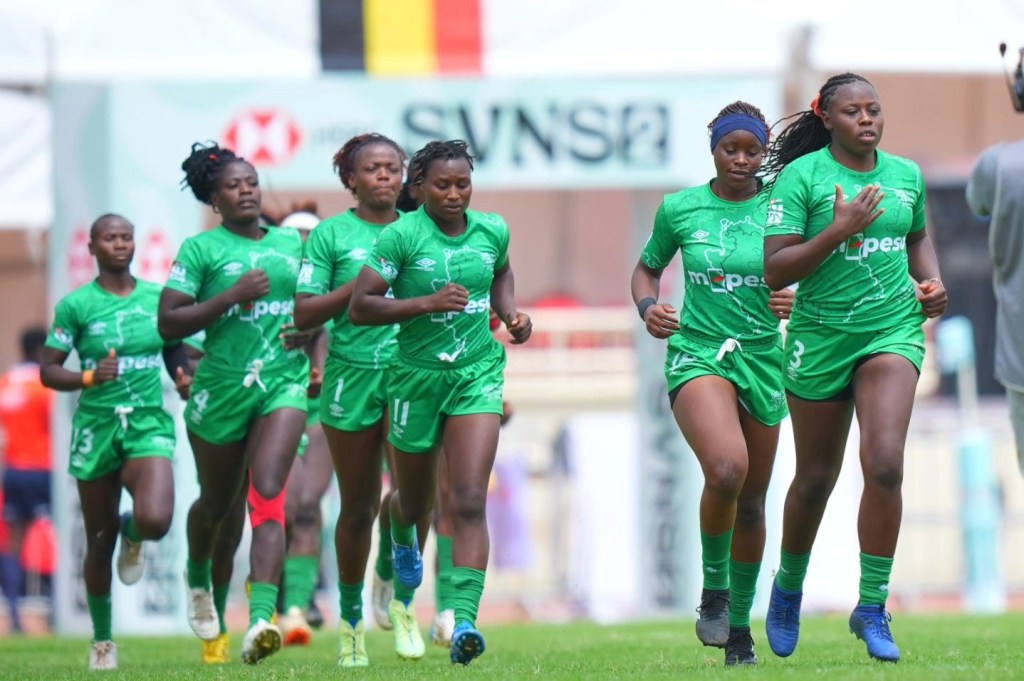
Kenya Lionesses must climb out of a deep hole they have dug after the completion of the opening tournament. While it may not be a monumental task considering the margins in Nairobi, the concern of recording only one win is a major worry.
The role played by unpaid allowances could have also been reflected in the performance. Two weeks before the tournament, Kenya Rugby Union admitted a backlog in unpaid allowances for the players without a clear indication on ensuring payment. Similarly, there has been a disquiet among the player unit regarding this issue.
Simon Odongo, the Kenya Lionesses head coach admitted in an interview that the tournament was tough but quickly added there was hope considering the narrow win and losses over the two days. “We lost by less than seven points which means we are not far off from getting all the five wins so we have to go back and strategize for the next two tournaments,” he stated.
Technical Deficiencies
When put on the spot about some of the technical deficiencies such as retrieving kick offs, fitness, and handling pressure, Odongo attributed the lapse to nerves. He explained that because of pressure, the players were nervous since most of them had not experienced such a big stage. “It is a tough environment where one slip could be crucial to winning or losing a game,” the coach observed.
In the next two tournaments, Kenya Lionesses have to be efficient and quickly address the deficiencies if they were to finish among the top four and qualify for the championship. “We have to be efficient and the big task will be cleaning the areas and ensure we commit less mistakes,” he offered.
One of the key areas is restarts. “We have to look at our restarts. We don’t have tall players so we have to adapt. High balls is not one of the skills taught in schools so since some of our players start late, they lack these basic skills,” Odongo explained. The coach defended the fitness of the players basing his argument on the lean margins. Asked why the players appeared slow, he countered: “They look sharp.”
Team Vulnerable
Freshia Oduor, one of the co-captains put up a brave face but admitted the team was vulnerable in retrieving kick offs. “We need to catch our kick offs. We realized the pressure came from this area,” she admitted.
Oduor explained that despite the pressure, the players stayed in the fight. “We will go back to the drawing board and address the shortcomings which include catching high balls, scoring first to relieve pressure, and convert every opportunity.”
After reviewing all the matches played over two days, there are many areas of concern as stated above. Key to a better performance is identifying clear leadership roles within the team to ensure passage of crucial information down the line. This will curtail individual play.
Kenya Lionesses are missing three key components: an enforcer, out and out pace, and a playmaker. South Africa had Nadine Roos as a playmaker and Maria Tshiremba, the flier. They also have a key enforcer in Shiniqwa Lampretch.
Collective Responsibility
Las Jaguaretes, the winners provided the player of the tournament Sofia Gonzalez. The team depends on collective responsibility that revolves around Cristal Escalante and Talia Rodich. Brazil has Thaila Costa and Bianca Silva who are hard to beat in open space while Spain has Carmen Miranda and China, Qian Xin.
Also, Kenya Lionesses are predictable which makes it easy for the opponents to shut them down by employing rush defense. Other areas that need a quick resolution are kicking for goals, quick adaptability if the planned approach fails and most importantly, a finishing power to stack up points which may be the difference at the next two tournaments.
Equally important is a critical look at the technical bench that only has a head coach. The Shujaa bench which meets the minimal standards has a head coach, an assistant and a strength and conditioning coach who complement one another.


 Sports News Arena